
Spirit Hawk · The Folklore of the White-tailed Kite
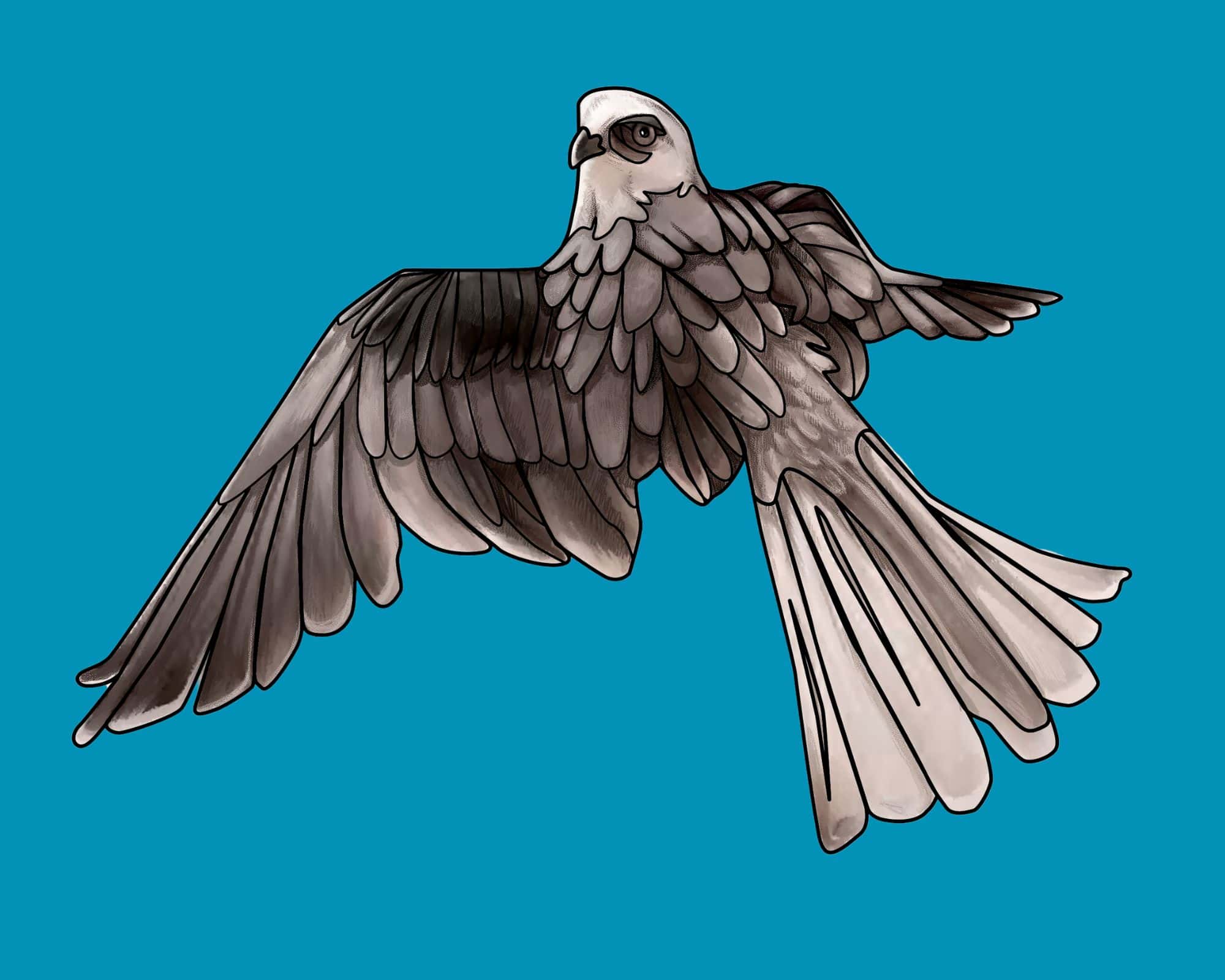
For centuries, hovering kites have been seen as more than birds—called spirit hawks, angel hawks, and sky watchers, their pale wings compared to ghosts in the air. To watch one pause midair, suspended as if by invisible strings, is to feel something uncanny, as though the ordinary laws of nature have been set aside.
Today science names it the White-tailed Kite, a small raptor finely tuned for hunting rodents across grasslands and savannas. Yet the sense of wonder has never faded. Its white plumage and motionless hover continue to blur the line between the natural and the supernatural, giving rise to stories, symbols, and a folklore that lingers wherever the bird is seen.
Natural History
The White-tailed Kite (Elanus leucurus) is a small, elegant raptor that carries itself with the grace of something half-bird, half-apparition. Its body is dressed in white and soft gray, with bold black patches at the shoulder. At a glance, it looks delicate, but in truth it is built for precision hunting.
Unlike most hawks and eagles, kites do not soar in broad circles. Instead, this bird hovers—facing into the wind, wings trembling in place, tail fanned wide, every muscle tuned to the subtle shifts of air. From this vantage, it scans the grass below for the flicker of mice and voles, then drops like a pale blade into the field.
Its range stretches widely across the Americas: from the coastal valleys of California, through the prairies and deserts of Mexico, down into the savannas of South America. Though often solitary when hunting, the kite is unusual among raptors in its willingness to roost communally. Dozens may gather in a single stand of trees, their white forms crowding the branches at dusk—a rare and ghostly congregation. Juveniles, tinged with buffy brown on the chest, add warmth to the otherwise spectral palette, but soon molt into the bright plumage of the adult.
Both hunter and vision, the White-tailed Kite is a bird that seems designed to blur boundaries: flesh and spirit, motion and stillness, predator and phantom.
Folklore & Mythology
Compared to owls or eagles, the White-tailed Kite leaves only a faint trace in the world’s great mythologies. It is not the thunderbird of North America, nor the owl of Athena. Yet its pale body and ghostlike hover have earned it names and associations that lean toward the supernatural.
Early Spanish and Mexican settlers often called it the milano blanco—the white kite. The name carried connotations of purity and brightness, setting it apart from the darker hawks, vultures, and caracaras that shared its skies. In California, 19th-century naturalists described the bird as “angel hawk,” struck by the way its hovering form seemed less like a predator and more like a spirit holding steady in the air.
In Central America, a kite suspended over a field was sometimes read as a sign of change—a stillness that foretold fortune shifting, weather turning, or events about to unfold. Its uncanny ability to hang in place made it feel like a messenger marking a pause in time.
Though it never anchored itself in epic myth the way owls and eagles did, the White-tailed Kite slipped quietly into local sayings and field lore as a sky watcher. Even in modest folklore, it carried an air of vigilance and mystery—a bird that seemed always to see more than it should.
Symbolism in Color and Behavior
Few birds feel as spectral as the White-tailed Kite. Hanging motionless in the wind, it seems less a creature of bone and muscle than an apparition suspended above the earth. This hovering presence has long encouraged people to see it as a symbol of spirits—an angel in daylight, a ghost watching over the fields.
Its white plumage deepens the impression. Across cultures, pale animals have carried symbolic weight: white deer as omens of transformation, white ravens as harbingers of mystery, albino creatures as messengers between worlds. The kite fits easily into this tradition. Its brightness against the open sky suggests purity and transcendence, while its sudden dives remind us that even the most ethereal form has sharp, earthly power.
Together, the bird’s colors and behavior create a living symbol of duality: fragile yet fierce, spiritlike yet tangible. The White-tailed Kite embodies the tension between what is seen and what is felt, the natural and the uncanny.
Story Meets Science
The ghostly reputation of the White-tailed Kite is born from its most practical behavior—hovering. To the human eye, a bird holding steady in midair looks like magic, a suspension that defies wind and weight. Folklore cast this stillness as spiritual, a pause between worlds. Science, however, shows it as survival: rapid wingbeats balanced against air currents, tail spread for control, eyes fixed on the ground. What seems supernatural is, in truth, a finely tuned hunting strategy.
Ecologically, the kite plays a vital role as a hunter of rodents, helping balance grassland ecosystems. To farmers, this made it both practical ally and eerie presence. Imagine watching a pale form hang above a field at dusk, then plunge like a ghost into the crops—at once blessing and omen.
In this way, story and science run in parallel. The bird is both predator and phantom, its biology feeding the folklore, its folklore reminding us that the natural world often feels larger than its explanations.
Encounters & Human Imagination
For those who have stood in a field and looked up at a hovering kite, the memory lingers long after the bird has flown. Farmers once spoke of them as “wind spirits,” guardians suspended above the rows of grain. Early naturalists, unable to resist the poetry of the moment, described the kite’s stance as “a motionless miracle,” a body somehow held aloft by nothing at all.
Even today, birders often recount their first encounter in uncanny terms. A white form drifts into view, then halts—utterly still yet trembling at the edges, as though time itself has paused. To many, it feels like being noticed by something outside the ordinary run of life. Field guides reflect this same struggle with language, leaning toward words like “ethereal,” “ghostlike,” and “spirit of the grasslands.”
Conservationists have their own layer of meaning. When White-tailed Kites began to return to California after decades of absence, biologists described the experience as if a phantom had reappeared. Sightings were celebrated not only as data points but as living proof that a vanished presence could come back. Whether in folklore, field notes, or casual encounters, the kite has always nudged human imagination toward wonder.
Conservation & Cultural Legacy
The White-tailed Kite’s story in North America mirrors the folklore that casts it as a ghost: once nearly gone, then returning as if from beyond. By the early 20th century, the bird had vanished from much of California. Habitat loss, shooting, and the plowing of open grasslands pushed it to the brink, and for years its pale form was almost a rumor. A kite sighting became rare enough to feel legendary, a ghost story with wings.
But the story didn’t end in disappearance. Mid-century protections—stricter laws against shooting raptors, conservation of wetlands and grasslands, and changing land practices—opened the door for recovery. Slowly, the kites began to return. By the 1990s, they were once again a regular sight in California’s Central Valley, white shapes hovering where none had been for decades.
That return gave the bird new symbolic weight. The kite became not just a figure of folklore, but a living emblem of resilience—proof that even a ghost can reappear when the land is given a chance to heal. Today it is both ecological ally, keeping rodent populations in check, and cultural icon, carrying forward its aura of mystery into a new era.
Between Fact and Fable
The White-tailed Kite is not an angel, nor a ghost, nor a messenger from beyond. Yet standing beneath one as it holds itself motionless against the sky, it is easy to understand why people reached for those words. Its pale wings blur into light, it has an intensity that feels unnatural, and its stillness defies the wind itself.
Science explains the mechanics—wingbeats, air currents, eyesight, prey. But explanation does not erase impression. To the farmer, it was once a sign of change; to the naturalist, an angel in the air; to the birder today, a fleeting spirit above the grasslands. Each is true in its own way.
Perhaps that is the kite’s greatest gift. It reminds us how easily the ordinary becomes extraordinary, how biology shades into story. The White-tailed Kite lives between fact and fable, predator and phantom, real bird and living symbol—a reminder that nature is never only what we measure, but also what we imagine.


