Buzzard or Spirit Bird? The Myth and Meaning of the Turkey Vulture
High above, dark shapes circle slowly, wings tilted in a lazy V. To many, the sight of vultures is a bad omen—death in the sky, shadow on the earth. The Turkey Vulture, with its bald red head and carrion diet, has long carried that reputation. Yet across cultures it is also seen as purifier, transformer, even messenger between worlds. More than a scavenger, it is a bird that forces us to face the uneasy truth: life is fed by death, and what seems foul is often what keeps the living safe.
Natural History
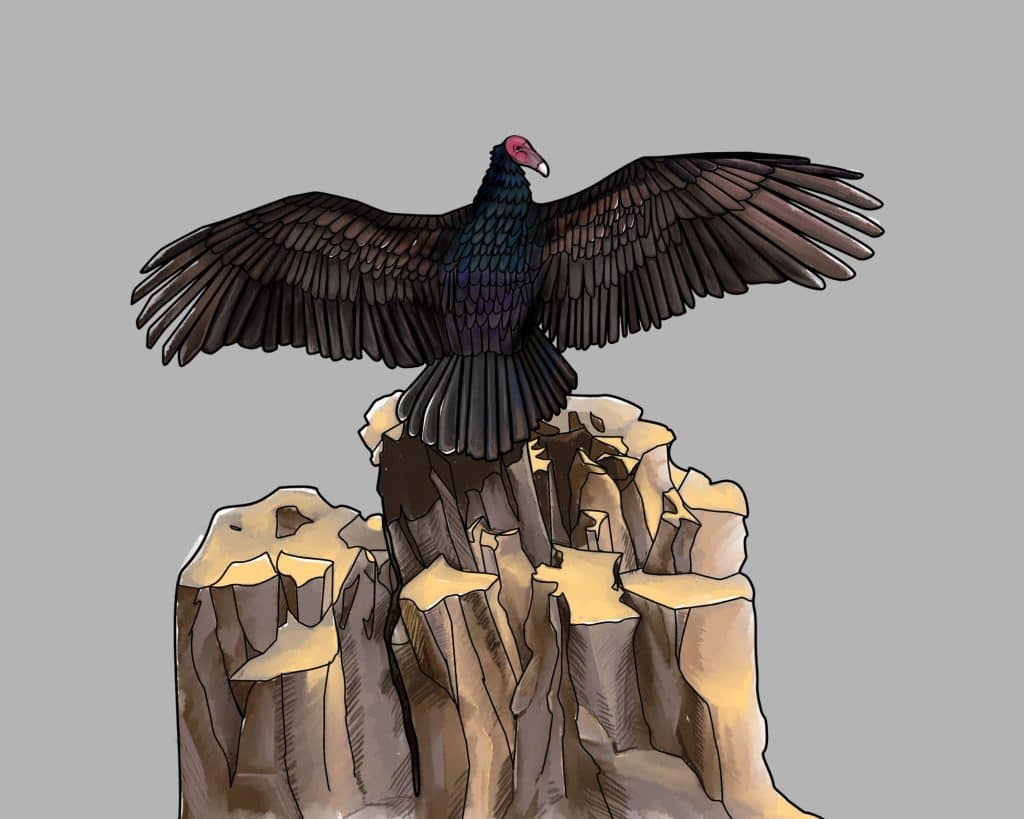
The Turkey Vulture (Cathartes aura) is among the most familiar raptors of the Americas. With a wingspan reaching six feet and a dark, heavy body, it soars effortlessly on rising thermals, wings held in a shallow V and rocking slightly as it glides. Its bald red head gives it the “turkey” name, while its dark plumage and circling flight often mark it in human eyes as a bird of death.
Unlike most birds of prey, the Turkey Vulture rarely kills. Instead, it feeds almost entirely on carrion. Its sense of smell—one of the keenest among birds—allows it to detect the faintest trace of decay from miles away. In this way, it serves a vital ecological role, cleaning the landscape and preventing disease.
Widespread from Canada to the tip of South America, the Turkey Vulture thrives in deserts, forests, grasslands, and towns alike. It roosts communally, sometimes by the dozens, a sight that can stir unease but also speaks to its resilience. Common, adaptable, and ever-present, it is a scavenger that has shaped both ecosystems and imaginations.
Folklore & Mythology
In Mesoamerica, the Turkey Vulture carried meanings of both decay and renewal. The Aztecs saw vultures as symbols of purification—creatures that consumed death so that life could continue. Mayan traditions placed vultures as intermediaries between the living and the underworld, messengers that traveled freely across realms. Their presence in carvings and codices reflects this dual role of corruption and cleansing.
Farther south, in the Andes, relatives of the Turkey Vulture shared the stage with the condor in myth. Both were revered as sacred carrion birds, essential to the balance between life and death. To feed on what had died was not simply unclean—it was transformative, a necessary act in the turning of the world.
In North America, stories often leaned toward fear. Among some Indigenous groups, vultures were associated with death, illness, or bad fortune, their circling flight read as an omen. Settlers and travelers carried this further, calling them “buzzards” and treating them with suspicion, likening them to the unclean scavengers of biblical deserts.
Yet across these traditions, the vulture remained more than just a bird of misfortune. It was a being tied to thresholds and transformations—a figure that bore the stigma of death but also the sacred duty of keeping the world alive.
Symbolism in Color and Behavior
The Turkey Vulture’s appearance and habits have always invited symbolism. Its bald red head suggests blood and fire, tying it to images of death, corruption, and the underworld. Dark plumage reinforces the association—shadows circling overhead, reminders of mortality drifting on the wind.
Yet its behavior carries different meanings. The vulture’s soaring flight, effortless and sustained for hours, evokes patience, endurance, and the slow turning of time. Its circling above the land is both feared as a sign of disaster and revered as a mark of vigilance, a creature that waits without hurry.
By feeding on carrion, the vulture embodies one of the most powerful symbols in nature: transformation. It takes what has died and returns it to the living world, purifying through decay. In this role it becomes a paradox—feared as a scavenger, yet essential as a cleanser, a bird that reveals the closeness of death and life.
Story Meets Science
The Turkey Vulture’s reputation as a death-bird comes straight from what people see: a bald head, a red face, a circling flock above the fields. Folklore reads these signs as omens, warnings that misfortune is near. Science offers a different story.
The bare head, seen as grotesque, is in fact an adaptation—easier to keep clean when feeding deep inside a carcass. The circling flight, often mistaken as waiting for something to die, is usually just a way to ride thermals and cover ground efficiently. Even the smell of decay, which people find revolting, is the vulture’s gift: an extraordinary sense of smell that allows it to find carrion others would miss.
What myth calls foul, biology calls necessary. By consuming the dead, vultures prevent the spread of disease and recycle nutrients back into the ecosystem. Where folklore saw corruption, science sees renewal. The Turkey Vulture’s story shows how a single set of behaviors can be feared as sinister or honored as essential, depending on the lens through which we look.
Encounters & Human Imagination
Encounters with Turkey Vultures often stir mixed feelings. For many, a kettle of vultures circling overhead still sparks unease, the old reflex of reading them as omens of death. Farmers once feared their presence as a sign of sickness among livestock; travelers saw their shadows as harbingers of misfortune on the road ahead.
Yet for others, the sight is strangely captivating. Watching vultures tilt and drift on invisible currents, rising without effort, can feel like a lesson in patience and endurance. Birders often describe them with a mix of respect and surprise—common, even ordinary birds that nonetheless carry a sense of the uncanny.
The vulture’s abundance ensures it is never far from human imagination. Whether feared as a scavenger, admired as a soaring presence, or reconsidered as nature’s quiet custodian, the Turkey Vulture continues to provoke reflection on how we see death, survival, and the uneasy space between.
Conservation & Cultural Legacy
Unlike many raptors, the Turkey Vulture has remained widespread and resilient. Its adaptability—feeding on almost any carrion, thriving in deserts, forests, and even near towns—has allowed it to avoid the steep declines faced by other vulture species worldwide. Yet it often suffers from misunderstanding. Seen as dirty or ominous, it has been persecuted, shot, or poisoned alongside livestock carcasses, despite playing no role in harming animals.
Globally, vultures carry a different legacy. In India and Africa, steep declines in vulture populations have revealed just how vital scavengers are—without them, carcasses linger, disease spreads, and ecosystems falter. These lessons cast the Turkey Vulture in a new light: not a bird of corruption, but a guardian of public health and ecological balance.
Culturally, it remains a figure of paradox. In folk traditions it is a death-bird; in conservation, it is a model of survival. Its very presence challenges human ideas of what is clean and what is foul, what is feared and what is necessary. The Turkey Vulture’s legacy is one of endurance—living proof that even the most maligned creatures can be essential to the life of the world.
Fact and Fable
The Turkey Vulture is both what people fear and what the land requires. In story, it is the omen circling above, the red-faced harbinger of death. In science, it is the purifier, the bird that takes corruption and turns it back into life.
Neither view is wrong. The vulture’s bare head, dark plumage, and carrion diet naturally invite dread. Its soaring flight, patience, and ecological service reveal a different truth: that death feeds life, and endings are never the end.
Seen through myth, it is shadow and omen. Seen through biology, it is survival made visible. Together, these truths remind us that what seems foul may also be sacred, and that the line between fact and fable is no line at all, but a circle—like the one a vulture traces across the sky.