
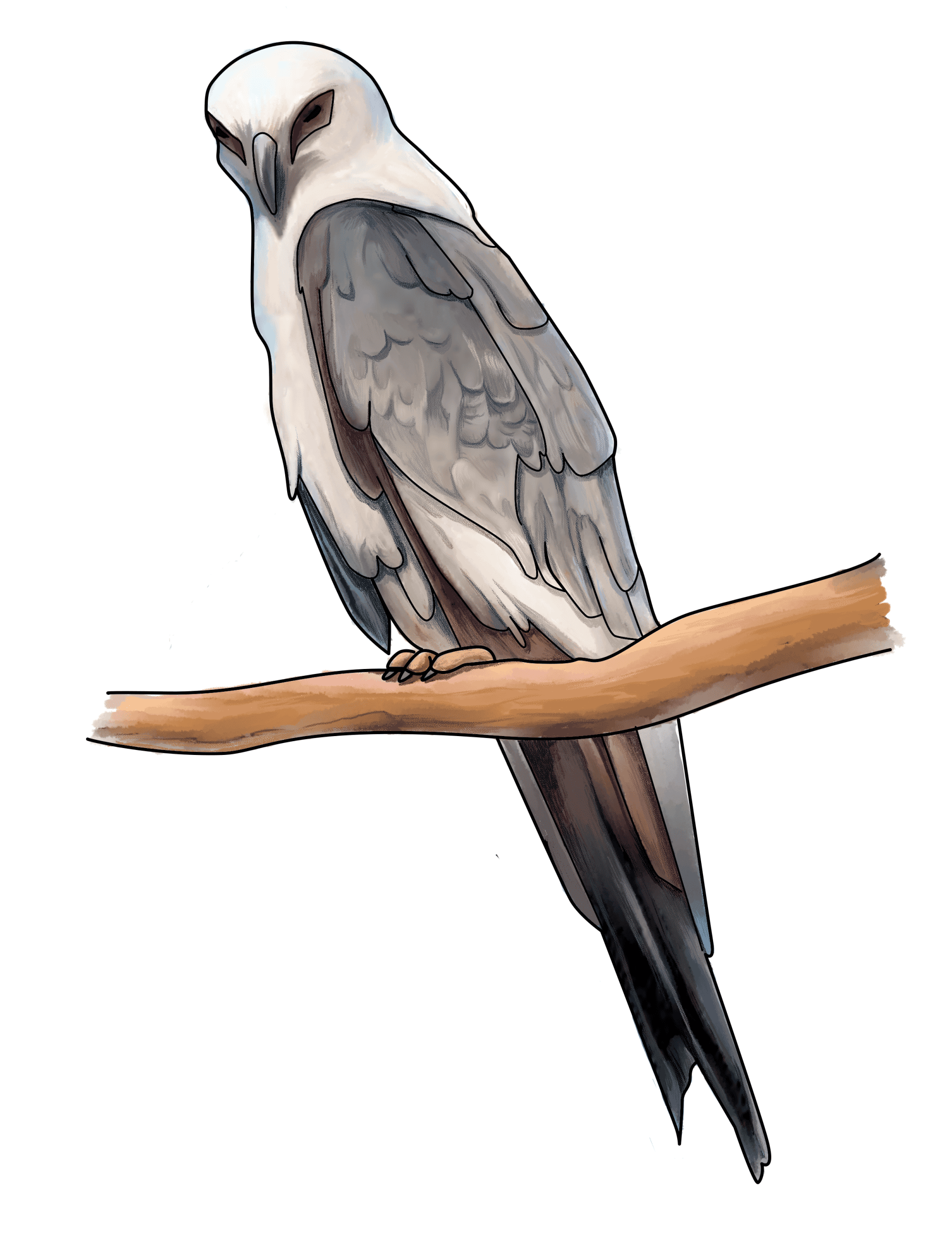
Also known as the summer kite, the Mississippi Kite is a raptor built for the open sky. Unlike hawks that ambush from perches or eagles that muscle heavy prey from the ground, these kites specialize in insects, plucking them from the air with effortless grace. Their long, pointed wings and slim bodies give them a falcon-like silhouette, but their style is smoother, more buoyant, as if the air itself bends to carry them. In summer across the southern United States, they become part of the season’s fabric — circling high above towns, fields, and rivers, floating with ease while cicadas buzz below.
- Length: 12–15 inches (30–38 cm)
- Wingspan: 36–40 inches (91–102 cm)
- Range: Breeds across the south-central and southeastern U.S. from Texas and Oklahoma to the Carolinas. Winters in South America, with thousands gathering into flocks for the long journey south.
What to Look For
At first glance, the Mississippi Kite can be mistaken for a falcon, its long, pointed wings slicing through the air with ease. But look closer, and its softer, sleeker design comes into focus. Adults are clad in smooth gray, pale on the head and darker on the wings, giving them a subtle, two-toned look that glows silver in bright sun. The effect is understated compared to the bold contrasts of hawks or eagles, but in good light, their elegance is unmistakable.
Juveniles tell a different story. Brown and streaked, with pale wing panels that flash when they bank, young kites are easily told apart from adults but can confuse the unwary observer. With practice, though, even their shape gives them away: slim bodies, long wings, and buoyant flight unlike the heavier, plank-winged buteos.
In the air, they are masters of efficiency. Their wings taper to fine points, their tails narrow, and their movements flow as if each glide is pulled along invisible currents. A Mississippi Kite drifting over a summer field doesn’t labor or wobble — it floats, turns, and banks with fluid precision, always scanning for the flicker of insect wings below. Once you’ve seen that combination of form and motion, the bird becomes instantly recognizable.
Behavior & Flight Style
The Mississippi Kite lives in the air. While many raptors divide their time between perches and patrols, this bird spends its days aloft, weaving the sky with smooth arcs and effortless glides. Its long, pointed wings give it speed when needed, but more often its flight feels unhurried — buoyant, almost playful, as it floats over fields, towns, and river valleys.
Hunting is a performance of agility. Kites catch insects on the wing, snatching cicadas, dragonflies, or grasshoppers in midair and often eating them without landing. A sharp twist, a sudden dip, a quick snap of the bill — and the meal is gone before the bird has even broken its glide. During cicada hatches, groups of kites may gather, sweeping back and forth like acrobats, each turn a display of precision and ease.
On the ground or perched in trees, they are understated, blending quietly into the canopy. But in the air, they transform into aerial specialists — fluid, efficient, and endlessly graceful. Watching a Mississippi Kite hunt in summer is to see a raptor that has traded brute strength for finesse, a predator that turns the simple act of catching insects into a kind of art.
Diet & Hunting
For the Mississippi Kite, the sky itself is a dining hall. Unlike hawks that stoop onto rodents or eagles that wrestle fish from the water, this bird feeds almost entirely on insects — caught and consumed in midair. Cicadas, grasshoppers, dragonflies, and beetles make up the bulk of its summer diet, their buzzing swarms turning fields and towns into buffets for these aerial hunters.
The hunting style is as elegant as it is effective. A kite glides smoothly above a field, then tilts, twists, and plucks an insect from the air with a precise snap of its bill. Often, it eats on the wing, folding its prey into its talons, passing it forward, and swallowing without breaking its glide. During peak insect seasons, Mississippi Kites may hunt in loose groups, each bird carving graceful arcs through the sky, sharing the air like dancers in a slow-motion routine.
Though insects dominate, kites are opportunists within their narrow niche. They will occasionally drop low to snatch small reptiles, amphibians, or even bats, but these are side notes in an otherwise insect-driven life. Their reliance on flying prey defines their movements, their migrations, and even their social patterns. Where the air hums with insects, the Mississippi Kite thrives.
Migration & Range
The Mississippi Kite is a bird of seasons. In spring, they sweep north into the United States, arriving across the south-central and southeastern states just as the air fills with insects. From Texas and Oklahoma through the Carolinas, they nest in woodlands, shelterbelts, and even small towns, their buoyant silhouettes a sign that summer has settled in. By late summer, their numbers peak, with adults feeding fledglings and flocks circling high on thermals.
Come fall, the skies change. Kites gather into loose flocks and drift southward, often kettling in thermals alongside Broad-winged Hawks and other migrants. Their journey takes them thousands of miles, across the Gulf of Mexico, through Central America, and deep into South America, where they spend the winter in open savannas and forest edges.
Unlike year-round residents such as Red-tailed Hawks, Mississippi Kites are true migrants, absent from the U.S. outside the breeding season. Their presence is brief but unmistakable — a gray ghost of summer skies, here for only a few months before slipping away to the southern hemisphere.
Nesting & Life Cycle
Mississippi Kites are communal in spirit, often nesting in loose colonies where several pairs occupy the same grove of trees. Their nests are modest platforms of sticks, lined with leaves and green twigs, tucked high into cottonwoods, oaks, or pecans. Increasingly, they have adapted to human settings, building in city parks, shelterbelts, and even suburban neighborhoods, so long as open hunting grounds are nearby.
Courtship is graceful and aerial. Pairs wheel together above the treetops, exchanging whistles and sometimes passing food in midair — a ritual that seals their bond. Once nesting begins, the female lays one to three eggs. Both parents share incubation, taking turns on the nest, and both are fiercely protective. Intruders, whether crows, hawks, or even people passing too close, are often harassed by swooping adults diving from the canopy.
The young hatch after about a month and are fed a steady diet of insects delivered by both parents. Growth is fast, fueled by protein-rich prey, and within four to five weeks the chicks fledge, joining their parents in the skies. Even after leaving the nest, fledglings linger nearby, perfecting the acrobatic flying skills that define the species. By late summer, they gather with other families into loose flocks, preparing for the long journey south.
Sounds
The Mississippi Kite’s voice is as thin and high as its flight is smooth. Their most common call is a sharp, whistling peeeew that rises and falls, carrying across fields and neighborhoods on summer air. In flight, especially when circling above their nests or drifting with other kites, the notes can sound plaintive, almost gull-like, a faint cry against the backdrop of cicadas.
Around the nest, the calls become more insistent. Adults exchange shorter whistles when relieving each other at incubation or when delivering food, while fledglings beg with high, squeaky cries that build to a chorus as parents approach. When alarmed, they give a series of rapid, piping ki-ki-ki notes, often paired with defensive dives at intruders.
The sound may not be dramatic like the scream of a Red-tailed Hawk, but it is distinctive — a thin, piercing whistle that seems perfectly tuned for summer skies. Once you learn it, the call becomes part of the landscape, a signal that Mississippi Kites are overhead even when they drift almost invisibly against the light.
Conservation
Unlike many raptors that have declined under pressure from habitat loss, the Mississippi Kite has adapted — and in some places, even expanded. Once confined mostly to the South, they’ve spread northward into the Great Plains and Midwest, following tree planting in towns and farms that provide new nesting opportunities. Their ability to thrive in both wild savannas and suburban neighborhoods has made them one of the few raptors to benefit from human-altered landscapes.
Still, their success is not guaranteed. Pesticide use that reduces insect prey remains a major concern, as does disturbance near nests. In some areas, their colonial nesting habits put them in close contact with people, sometimes leading to conflicts when protective adults swoop at unsuspecting park-goers or yard workers. Despite these challenges, overall populations remain stable or increasing, a rare bright spot among raptors.
Cool Fact: During late summer cicada hatches, Mississippi Kites often hunt cooperatively. Groups of kites sweep across the sky together, each bird twisting and snapping insects midair in what looks more like an aerial ballet than a feeding frenzy.
The Mississippi Kite is a raptor of summer skies — sleek, graceful, and built for the rhythm of warm air and buzzing insects. It doesn’t hunt with power or brute force, but with finesse, floating high above fields before tilting into effortless dives for prey.
For a few short months each year, their buoyant silhouettes and piercing whistles become part of the southern landscape, a reminder that not all raptors rule with talons alone.