
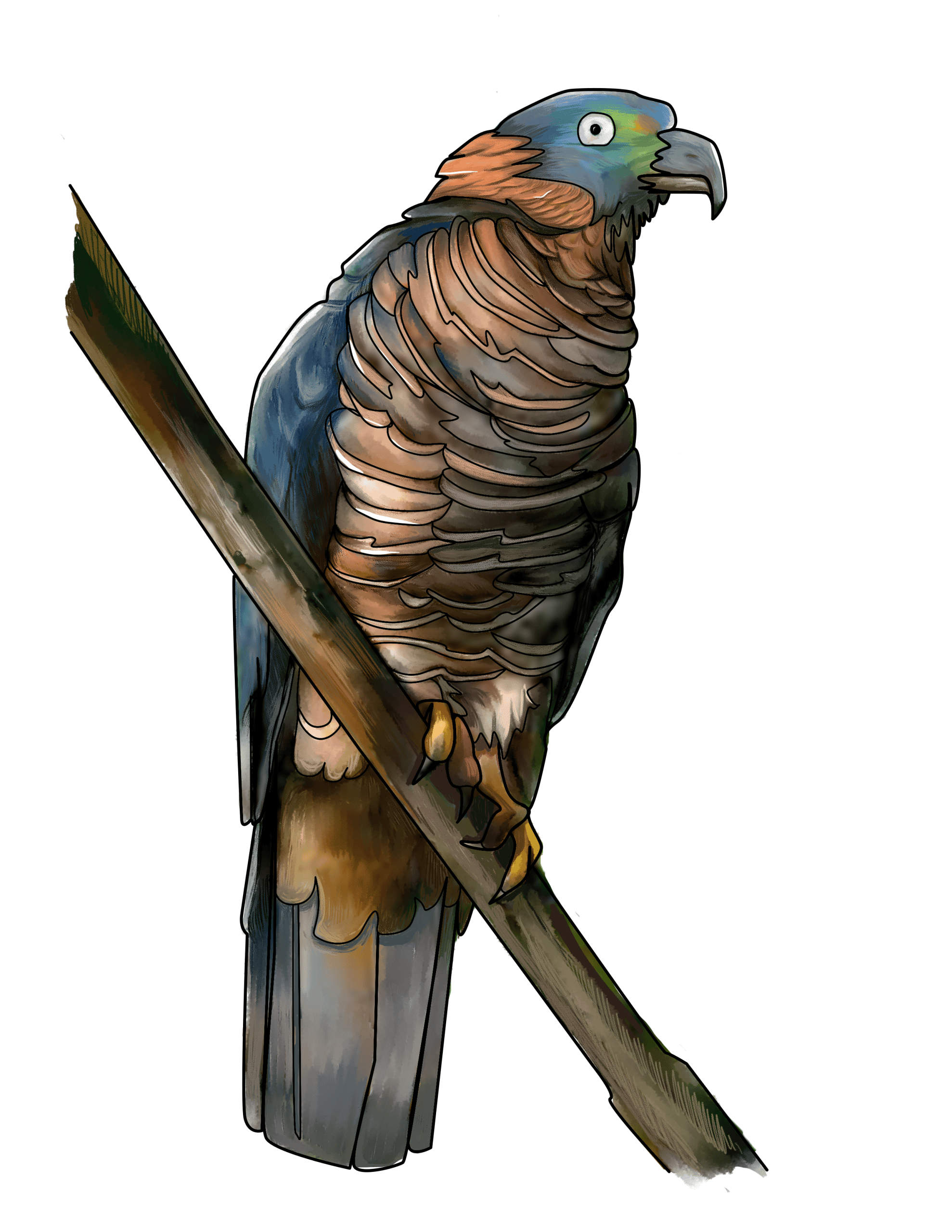
Also known as the snail breaker, the Hook-billed Kite is a tropical raptor built around a single purpose. Unlike hawks that chase mammals or falcons that dive for birds, this kite survives mainly on snails, its heavy, over-curved bill acting like a can-opener designed by evolution. Its presence is subtle — a slow, buoyant flyer over forest edges and wetlands — but unmistakable once you glimpse that massive, arched beak.
- Length: 15–20 inches (38–51 cm)
- Wingspan: 31–35 inches (79–89 cm)
- Range: From southern Mexico through Central and South America, including the Amazon Basin. In the U.S., it is a rare visitor to South Texas, usually appearing after storms.
What to Look For
The Hook-billed Kite’s identity rests in its name. That bill — heavy, deep, and sharply curved — looks oversized for the bird’s face, a tool shaped for prying snails from their shells. Even at a distance, the profile can seem exaggerated, a curve so strong it’s visible against the sky.
Males and females show different looks. Males are gray above with pale underparts and a finely barred tail, giving them a cleaner, sleeker appearance. Females are larger and browner, heavily streaked across the chest, with more contrast in the plumage. Juveniles resemble females but often show softer streaking. Across all ages and sexes, one feature unites them: that bill, black and imposing, a field mark you can’t mistake.
In flight, Hook-billed Kites look buoyant and relaxed, with rounded wings and a broad tail that fans as they drift over forest edges or wetlands. They don’t soar high like hawks or hover like kites of open country. Instead, their movement feels quiet and deliberate, a slow search above snail-rich ground. Perched in trees, they can seem inconspicuous, blending into the canopy until they shift and the outline of that immense bill gives them away.
Behavior & Flight Style
The Hook-billed Kite is a study in patience. It doesn’t patrol vast skies like a Red-tailed Hawk or hover like a White-tailed Kite. Instead, it moves slowly and deliberately along forest edges and wetlands, its flight buoyant and steady, almost reminiscent of a gull. Wingbeats are shallow and measured, broken up by long glides, as if the bird is conserving energy for the careful work of extracting snails.
Perched, it often disappears into the foliage, sitting quietly on a shaded branch until it slips into motion. When hunting, it quarters low over wetlands or perches near snail-rich pools, watching and waiting. This is not a bird of speed or spectacle, but of efficiency. Its movements are restrained, its presence subdued — until the moment comes to feed. Then the kite swoops to a perch with its prey and goes to work, that oversized bill prying shells apart with mechanical precision.
Hook-billed Kites are also less solitary than many raptors. In good habitat, you might see small groups foraging together, their quiet circling over a marsh a signal that snails are plentiful. But whether alone or in company, their rhythm is the same: unhurried flight, deliberate perching, and the slow, purposeful work of a bird that has found a narrow niche and mastered it.
Diet & Hunting
The Hook-billed Kite is one of the few raptors whose diet revolves almost entirely around snails. Its massive, over-curved bill is a perfect tool for the job — a natural lever designed to slip into the spiral of a shell and pry the animal free. Where most hawks rely on strength or speed, this kite relies on technique. Perched quietly above a marsh or gliding low over flooded ground, it locates a snail, plucks it up, and settles onto a branch or snag to begin the careful work of extraction.
The process is deliberate. Holding the snail firmly in its talons, the kite inserts its hooked bill into the opening of the shell, twists, and pries until the soft body is pulled free. The motion is slow, sometimes repeated several times, but once the technique is mastered it becomes astonishingly efficient. Unlike the Everglade Kite, which focuses on apple snails, the Hook-billed Kite adapts to a wider variety of snail species across its range, and its bill shows local variation — in some regions, birds have deeper or shallower curves depending on which snails dominate.
Though snails are the staple, the kite will occasionally take crabs, frogs, or insects when available. Still, it is a specialist at heart, thriving in wetlands and forests where snail populations are abundant. Watching one work a snail is less like watching a predator and more like observing a craftsman — methodical, precise, and wholly dedicated to the art of survival.
Migration & Range
The Hook-billed Kite is not a long-distance migrant. Instead, it is a resident of the tropics, staying close to the forests and wetlands that sustain it. Across southern Mexico, Central America, and much of South America, it can be found year-round wherever snails are plentiful. Its distribution is patchy, tied less to geography than to habitat quality — strong populations in snail-rich lowlands, absences in areas where wetlands have been drained or forests cut.
Seasonal shifts do occur. In parts of its range, especially where wet and dry seasons dominate, kites move locally, dispersing as water levels rise and fall. These are not grand migrations but subtle adjustments, guided by the presence of food. The birds follow snails, and snails follow the rhythm of rain.
In the United States, the Hook-billed Kite is little more than a ghost. Rare vagrants occasionally appear in the lower Rio Grande Valley of Texas, usually after storms push them north. These sightings are treasured by birders, not just for the rarity but for the chance to glimpse a raptor so finely tuned to tropical wetlands. For most of its range, though, the Hook-billed Kite remains firmly anchored to the tropics, a quiet resident of forests and marshes where specialization rules.
Nesting & Life Cycle
Hook-billed Kites nest quietly in the canopy, often in the shelter of a broadleaf tree overlooking wetlands or rivers. Their nests are modest platforms of sticks, lined with greenery, built 20 to 40 feet above the ground. Compared to the massive constructions of eagles or the sprawling piles of ospreys, these nests seem almost delicate, but they’re well hidden among the leaves, offering protection from predators and the tropical sun.
Pairs are monogamous during the season, and courtship is subtle: aerial displays over the treetops, gentle calling, and food offerings that reinforce the bond. Once nesting begins, the female lays one or two eggs. She takes on most of the incubation, which lasts around a month, while the male supplies food — snails carried to the nest and offered bill to bill.
The chicks hatch weak and downy, dependent on their parents not only for food but for the skill that defines the species. Both adults feed them with snail flesh, carefully torn from shells before being passed to the young. Growth is steady, and within five to six weeks, the fledglings are feathered and strong enough to make their first short flights. Still, they linger near the nest, shadowing their parents and beginning the long process of learning how to pry a snail from its shell — the single technique their survival depends on.
Sounds
The Hook-billed Kite is a quiet bird, its presence often marked more by silhouette than by voice. When it does call, the sound is a series of thin, high-pitched whistles or squeaky cries, often given in flight or during interactions between pairs. These notes can carry across a wetland, sharp but not powerful, more like a piping call than the harsh scream of a hawk.
Around nesting sites, the vocalizations grow more frequent. Males whistle as they deliver food, females answer with shorter notes, and chicks beg with squeaky, insistent cries that build until a parent arrives. Still, even at their most vocal, Hook-billed Kites are restrained, their voices blending into the chorus of tropical forests.
For birders, the silence is part of the challenge. Unlike a Red-tailed Hawk that announces itself with a scream, or a kite that whistles constantly above the fields, the Hook-billed Kite often slips by unnoticed — a shadow drifting above the canopy, bill glinting only when the light catches it.
Conservation
Across much of its range, the Hook-billed Kite remains widespread but never abundant. It is a bird of patchy distribution, tied closely to wetlands and snail-rich habitats. Where forests are cleared, marshes drained, or waterways polluted, the kites vanish quickly. In Central and South America, deforestation and wetland loss are the greatest threats, eroding the habitats where both the birds and their prey persist.
In the United States, the story is different. Here, the Hook-billed Kite is little more than a rare visitor, appearing sporadically in South Texas. Its small and isolated U.S. population, if it exists at all, is vulnerable to chance — dependent on wandering individuals and the health of habitats across the border.
Despite these challenges, the species as a whole is not globally endangered, thanks to its wide range. Conservation of wetlands, river systems, and forest edges remains the key to its survival, along with protecting the snail populations it depends on.
Cool Fact: The Hook-billed Kite’s oversized bill isn’t uniform across its range. In areas with large snails, the curve is deeper and more exaggerated; in areas with smaller snails, the bill is shallower. It’s one of the rare raptors whose anatomy shifts with local food supply — a living example of evolution in progress.
The Hook-billed Kite is a raptor shaped by one resource and one rhythm — a bird whose massive bill tells the story of its life before it even moves. It doesn’t scream across the sky or stoop in dramatic dives. Instead, it drifts quietly above forests and wetlands, waiting for the chance to pry open the shells that sustain it.
To see one is to glimpse a raptor as specialist, an evolutionary craftsman built for precision rather than power. In a world where generalists often thrive, the Hook-billed Kite endures by excelling at one thing — and doing it better than any other bird of prey.