
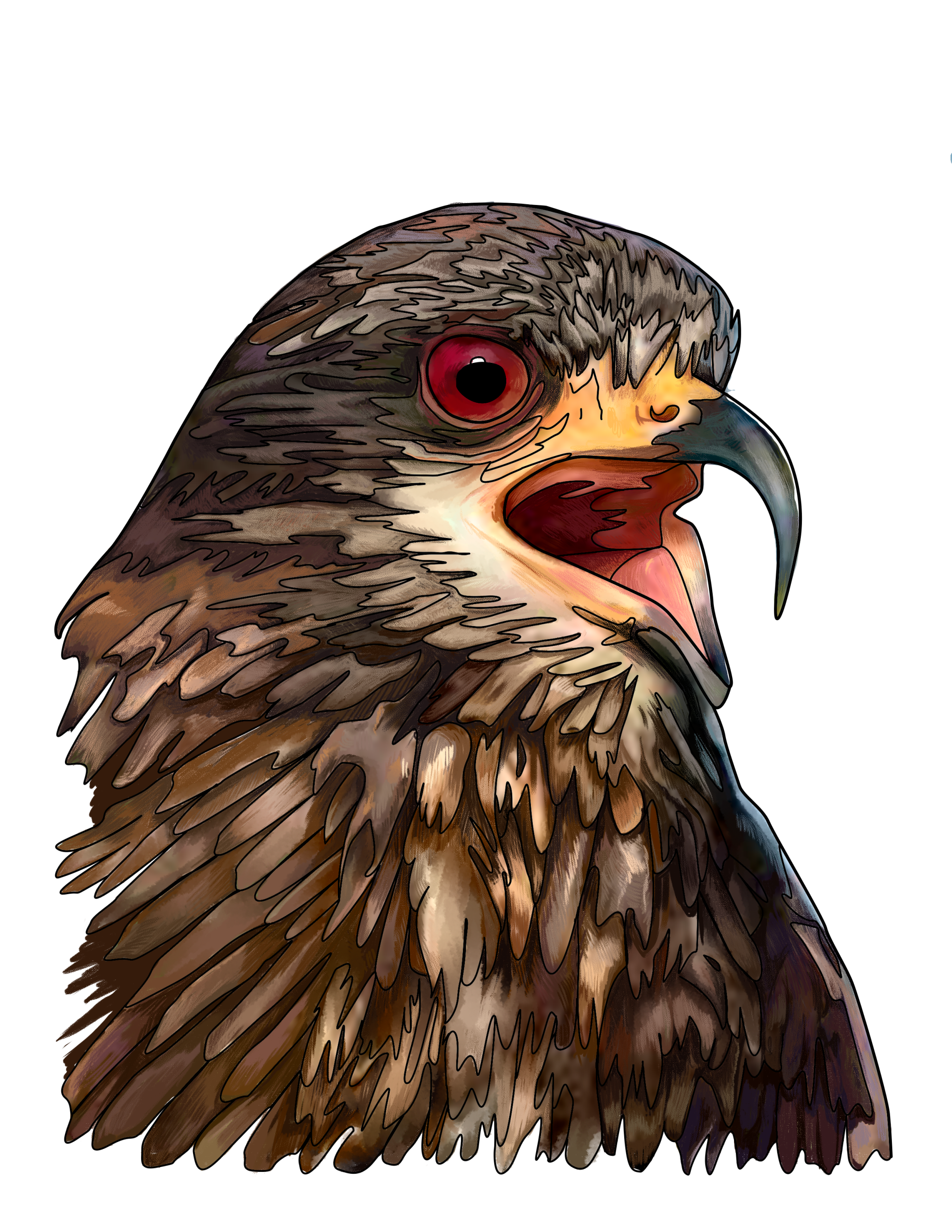
Also known as the snail hunter, the Everglade Kite is one of the most specialized raptors in the world. Unlike hawks that chase mammals or ospreys that plunge after fish, this bird has built its entire life around a single prey: the apple snail. Everything about it — from its buoyant, low flight to its razor-curved bill — is tuned to extracting snails from their shells in the shallow wetlands it calls home.
- Length: 14–17 inches (36–43 cm)
- Wingspan: 42–48 inches (107–122 cm)
- Range: Found across tropical and subtropical wetlands of the Americas, from Florida’s Everglades through the Caribbean and into Central and South America. In the U.S., it is almost entirely restricted to Florida marshes.
What to Look For
At first glance, the Everglade Kite can look like a small, dark hawk drifting low over marshes. But closer study reveals its unique design. Adult males are striking: slate-gray bodies offset by jet-black wingtips, a clean white rump patch, and a hooked black bill so exaggerated it looks oversized for the face. Add in red eyes and orange legs, and the male kite becomes a sharp, compact presence over the water.
Females tell a different story. Larger than the males, they are streaked brown with pale underparts and a bold white face pattern that gives them a hawk-like appearance. Juveniles resemble females but with softer, more mottled streaking, making them trickier to identify. Regardless of age or sex, one field mark unites them: the distinctive white rump patch that flashes like a signal every time the bird banks in flight.
In silhouette, kites appear slim and buoyant, with long, narrow wings and an easy, floating glide. They lack the heavy, plank-like profile of a buteo or the stiff, mechanical flapping of an osprey. Instead, their flight is loose and relaxed, almost gull-like, carrying them just above the reeds and lily pads where their prey lives. Once you’ve seen the shape — and the effortless way they quarter over a marsh — the Snail Kite becomes unmistakable.
Behavior & Flight Style
The Everglade Kite is not a raptor of drama but of patience. While hawks wheel high on thermals and falcons stoop at blinding speed, the kite skims just above the marsh, gliding with slow, deliberate wingbeats as if pacing the water’s surface. Its flight is buoyant and unhurried, almost gull-like, weaving back and forth across the wetlands in quiet search of snails.
Perched, it favors low vantage points: cattails, reed clumps, or half-submerged branches that keep it close to the shallow waters where its prey hides. From these perches, the kite watches carefully, sometimes slipping into short flights before settling again to scan the vegetation. Unlike generalist raptors that range widely and switch prey often, the Snail Kite’s behavior is tightly bound to its food source.
When foraging, the bird’s movements are deliberate and measured. A slow glide, a brief hover, and then a dip into the reeds to extract a snail. Once it has the prize, the kite’s specialized bill does the rest — sliding into the spiral of the shell, hooking deep, and drawing the snail out with surgical precision. The whole routine feels practiced, honed by countless generations to fit a single niche. Watching it work is less like seeing a predator on the hunt and more like watching a craftsman at his trade.
Diet & Hunting
The Everglade Kite is one of the most extreme specialists in the raptor world. While other hawks and eagles keep varied menus — mammals, birds, fish, even carrion — the Snail Kite lives almost exclusively on one prey: the apple snail. Everything about its feeding is built around this relationship. Its bill is thin, sharply hooked, and elongated, shaped less like a hawk’s chopping tool and more like a delicate instrument designed to pry. With it, the kite reaches deep into the snail’s spiral shell, sliding along the curve until it hooks the animal and draws it free in a single motion.
This technique is so precise that few other birds could replicate it. A heron or egret may spear snails, and ibises probe the mud for them, but no bird extracts them with the efficiency of the Snail Kite. Even young kites must learn the skill — juveniles often fumble or drop prey before mastering the art. Adults, however, make it look effortless, often finishing the job in seconds.
Though apple snails dominate their diet, the kites will occasionally take crayfish or other aquatic invertebrates when snails are scarce. Still, survival is tied almost entirely to the abundance of their chosen prey. When snail populations crash, the kites vanish, forced to disperse or perish. It’s a high-risk strategy in ecological terms, but one that has worked for millennia: ultimate mastery of one resource instead of compromise across many.
Migration & Range
The Everglade Kite is not a globe-trotting migrant like ospreys or broad-winged hawks. Instead, it is tied closely to the wetlands that support apple snails. In Florida, where the U.S. population is almost entirely confined, the birds shift locally as water levels rise and fall. During droughts, they may abandon one marsh and gather in another where snails remain abundant, but they rarely travel far. Their movements are measured, more like seasonal adjustments than true migrations.
Beyond Florida, the species has a much broader reach. Snail Kites are found across the Caribbean, Central America, and deep into South America, where vast marshes and river floodplains provide year-round habitat. In these regions, they can be locally common, soaring low over wetlands much as they do in the Everglades. Yet in the United States, their range is tiny and precarious, limited to the southern tip of Florida.
This dependence on a narrow habitat makes them especially vulnerable. Where marshes are drained, altered, or choked with invasive plants, the kites disappear. Where apple snails decline, the birds vanish with them. Their range is a reminder of how specialization, though remarkable, comes at a cost: the more precise the niche, the more fragile the foothold.
Nesting & Life Cycle
Snail Kites keep their nests close to the water that sustains them. Unlike hawks that build high in trees or eagles that construct massive platforms, these birds weave smaller, stick-based structures in shrubs, low trees, or dense marsh vegetation. From a distance the nests can look fragile, little more than loose piles of twigs, but up close they’re carefully layered with reeds and grasses to hold steady in the humid, shifting environment.
Pairs bond during the breeding season with aerial displays and food offerings, the male presenting captured snails to the female as both gift and proof of skill. Once paired, the female lays two to four eggs, pale with spots, which she incubates for about four weeks. During this time, the male provides much of the food, delivering snails to the nest in a steady rhythm.
When the chicks hatch, they are downy, weak, and completely dependent. Both parents feed them by tearing open snails and offering the soft flesh. Growth is rapid, fueled by this protein-rich diet, and within four to five weeks the young are capable of fledging. Even after their first flights, juveniles shadow their parents, practicing the delicate art of snail extraction — a skill that takes time and repetition to master. Survival depends not just on learning to fly, but on perfecting the singular technique that defines the species.
Sounds
The Snail Kite’s voice is surprisingly sharp for such a delicate-looking bird. Its most common call is a high-pitched, whistling peeeu or ki-yeeew, often given in flight or when alarmed. During the breeding season, males become more vocal, their whistles carrying across the marsh as they circle territories or approach the nest with food.
Around the nest, the calls shift to shorter, squeakier notes — quick exchanges between mates and insistent begging cries from hungry chicks. Unlike the harsh screams of hawks or the guttural grunts of vultures, the Snail Kite’s voice is thinner and more musical, almost falcon-like, but always functional.
Across a still wetland, the sound can feel faint and fleeting, lost in the rustle of reeds or the splash of herons. But once you learn the tone, it’s a clear signature of the bird’s presence — a bright thread of sound in the otherwise quiet rhythm of a marsh.
Conservation
The Snail Kite is one of the most vulnerable raptors in North America. In the U.S., its fate is tied almost entirely to the wetlands of southern Florida, where habitat loss, water management, and invasive species have pushed populations to the brink more than once. When marshes dry too quickly, or when invasive snails replace native ones, the balance tips against the kite. With such a specialized diet, even small disruptions ripple quickly through their survival.
Conservation efforts have focused on restoring Everglades water flow, protecting nesting areas, and monitoring apple snail populations. These efforts have brought the kite back from the edge before, but its future remains fragile. Across Central and South America, the species is more widespread and stable, but even there, wetland destruction poses ongoing risks.
Cool Fact: Few birds are so specialized that they live or die by a single prey item. The Snail Kite’s curved bill is the perfect tool for one job: extracting apple snails. Without them, the bird cannot survive — making it one of the most finely tuned examples of evolutionary specialization in the raptor world.
The Everglade Kite is proof that survival can be built on absolute precision. Where most raptors thrive on versatility, this bird thrives on mastery — a bill curved for one purpose, a flight style tuned for one habitat, a life written around the rhythm of apple snails.
Watching one glide low over a Florida marsh, then settle gently into the reeds to pull a snail from its shell, is to see evolution at its most exact. It is beautiful and fragile all at once — a reminder that the more specialized a species becomes, the more its fate is bound to the health of its home.